
AI agent infrastructure
Runtime Authorization for AI Agents: The Missing Security Layer for Autonomous AI
AI agents are moving from answering questions and generating suggestions toward deploying software, changing infrastructure, modifying databases, processing financial transactions, and updating enterprise systems.
The hard problem is no longer whether models can reason. The hard problem is runtime authorization for AI agents: what actions should an agent be allowed to take at the moment a consequential operation is about to happen?
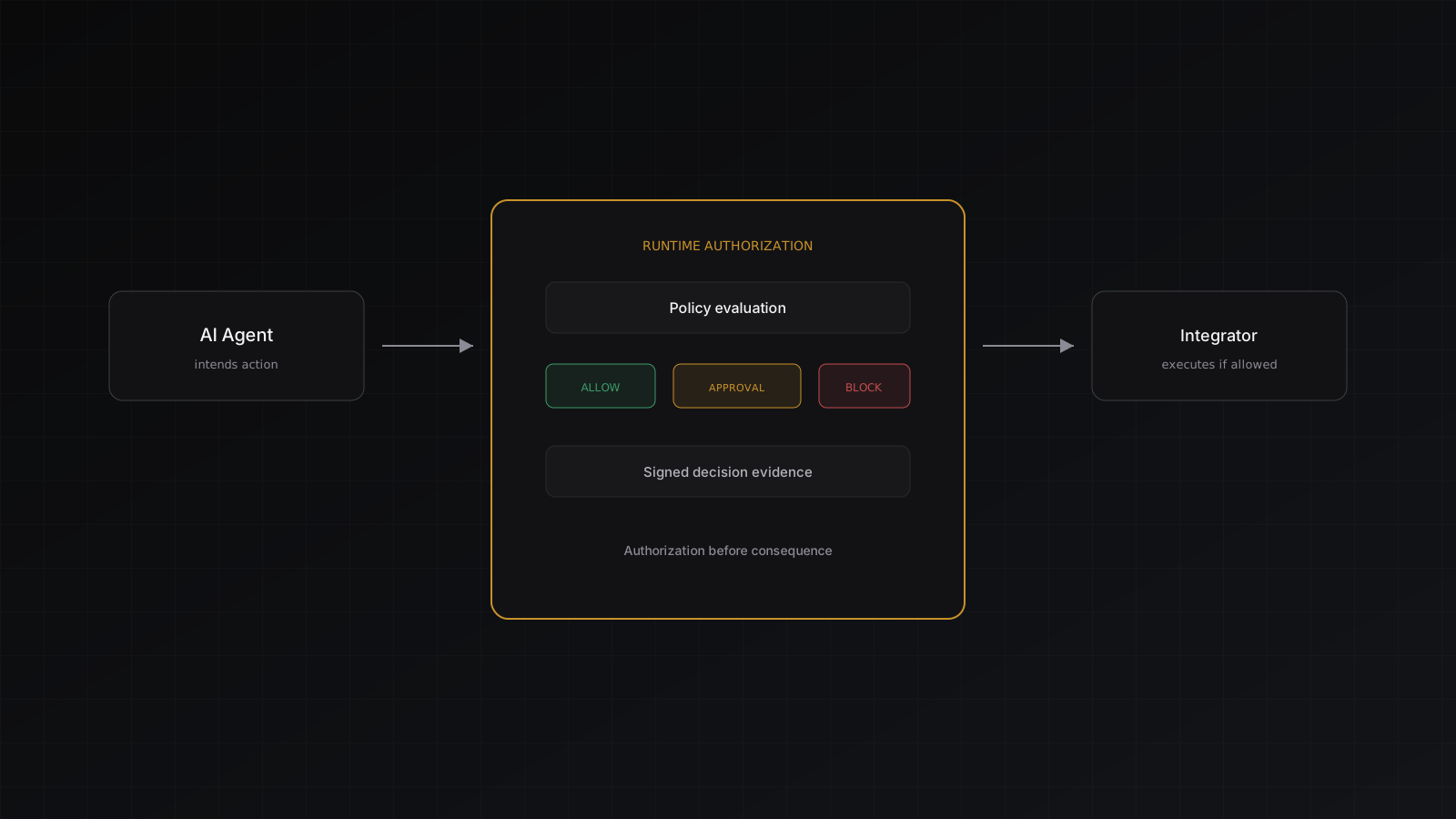
The AI agent security gap
Most AI agent platforms invest heavily in memory, tools, orchestration, and observability. Those layers help agents work and help operators understand what happened. They do not by themselves answer the question teams ask before trusting production AI agents:
What stops an agent from doing something dangerous?
That gap shows up wherever consequences are irreversible or externally visible: production deployment, deleting data, changing permissions, sending sensitive information, or approving payments. AI agent governance programs may define principles. Observability may show the blast radius after the fact. Runtime authorization decides whether the action should proceed before the consequence lands.
For coding-agent examples, see controlling AI coding agents before push or deploy. For containment versus authorization, see AI sandboxes vs runtime authorization.
Human approval without slowing AI agents
Human-in-the-loop does not mean reviewing everything. Over-approving low-risk work creates noise and weakens attention on consequential decisions. The useful model for human approval for AI agents is selective:
- Low-risk: ALLOW
- Medium-risk or contextual: REQUIRE_APPROVAL
- Dangerous or prohibited: BLOCK
For an AI coding agent, a practical pattern looks like this:
| Action | Context | Suggested decision |
|---|---|---|
| create_pull_request | Draft change; review still possible | ALLOW |
| merge_to_production | Consequential change to production branch | REQUIRE_APPROVAL |
| delete_production_database | Irreversible destructive operation | BLOCK |
That is how teams keep agents useful without treating every tool call as either fully autonomous or permanently blocked. More on approval workflows: Product.
Why AI agents need signed evidence
After a consequential AI action is requested—especially one that required escalation—organizations need an AI agent audit trail that answers operational questions:
- Which agent requested this?
- What action was requested?
- Which policy evaluated it?
- Who authorized it, if authorization was required?
- Can the decision record be trusted later?
Cryptographically verifiable authorization evidence helps answer those questions. The customer value is trust and accountability, not cryptography for its own sake: every consequential decision should leave a durable record of why it was allowed, escalated, or denied.
Details on signed decision evidence: Developers and Security.
Runtime authorization vs AI observability
Observability and authorization solve different problems. Observability asks what happened. Runtime authorization asks what is allowed to happen.
| Question | Observability | Runtime authorization |
|---|---|---|
| Primary question | What happened? | What is allowed to happen now? |
| When it operates | During and after execution | Immediately before consequential execution |
| Typical artifacts | Logs, traces, metrics, dashboards | Policy decision and signed decision evidence |
| Can require human authorization? | Usually not as a hard gate | Yes, via REQUIRE_APPROVAL |
| Does a decision prove execution succeeded? | No—observability records outcomes separately | No—authorization is not the outcome |
Logs, traces, and monitoring remain essential for production AI agents. They do not replace a decision boundary before deployments, payments, exports, or privilege changes. The layers work together.
How BobSentry approaches AI agent authorization
BobSentry is a runtime authorization layer for AI agents. It evaluates consequential actions before execution and returns ALLOW, REQUIRE_APPROVAL, or BLOCK according to policy.
In practice, that includes:
- a runtime decision layer at the action boundary
- agent identity separate from human and credential identity
- policy evaluation for actions and context
- approval workflows when policy requires human authorization
- signed decision evidence for the resulting decision
- a Simulator for testing policy decisions without operational side effects
BobSentry provides the authorization decision. The integrating system controls execution. In COOPERATIVE mode, the integration calls BobSentry and is responsible for honoring the decision before downstream execution. In OBSERVE mode, BobSentry evaluates and records what policy would decide without controlling execution. There is no customer-selectable ENFORCED mode today.
BobSentry does not execute the downstream action, and an authorization decision is not proof that the action succeeded. Those distinctions keep AI agent security claims grounded in how systems actually operate.
If you are operating agents that can already take consequential actions, start with the question that maps directly to this boundary: what actions does your team still refuse to let agents execute automatically? Become a design partner.
FAQ
What is runtime authorization for AI agents?
Runtime authorization for AI agents is a decision layer that evaluates a specific intended action immediately before a consequential operation occurs. It returns ALLOW, REQUIRE_APPROVAL, or BLOCK based on agent identity, action, context, and policy—then records evidence of that decision.
Why do AI agents need authorization?
AI agents can take actions with real operational consequences: deployments, payments, data exports, permission changes, and infrastructure mutations. Permissions may grant tool access, but they do not decide whether each specific action should proceed right now.
How is AI agent authorization different from API permissions?
API permissions answer whether a caller can access a capability. AI agent authorization evaluates whether this particular action—under current context, environment, risk, and policy—should be allowed to proceed, require human authorization, or be denied.
Should AI agents require human approval?
Not for every action. Low-risk reversible work can often ALLOW. Contextual high-impact actions can REQUIRE_APPROVAL. Prohibited or irreversible actions can BLOCK. Human review should concentrate on consequential decisions, not routine preparation.
How can companies safely deploy autonomous AI agents?
Start by listing actions the team still refuses to let agents execute automatically. Place an evaluate call before those actions. Use policy to allow safe work, escalate when needed, deny what must never run, and keep signed decision evidence. The integrating system remains responsible for honoring the decision before execution.
What is the difference between AI governance and AI authorization?
AI governance often covers principles, oversight programs, model documentation, and organizational controls. Runtime authorization is narrower and operational: it decides whether a specific agent action may proceed at the moment of consequence.
Related articles
- AI Sandboxes Protect the Host. Runtime Authorization Protects the Business.
AI agent infrastructure · 8 min read
- How to Control AI Coding Agents Before They Push Code or Deploy to Production
Developer agents · 12 min read