
AI agent infrastructure
AI Sandboxes Protect the Host. Runtime Authorization Protects the Business.
AWS, Google Cloud, Microsoft Azure, and Cloudflare now provide native environments for isolated agent-code execution. As covered in The New Stack, cloud platforms are making it easier to run model-generated code away from the host.
That progress matters. It does not answer the harder business question. Sandboxing contains code. It does not authorize business consequences. Runtime authorization decides whether a specific action—deploy, payment, export, infrastructure change—should execute now.
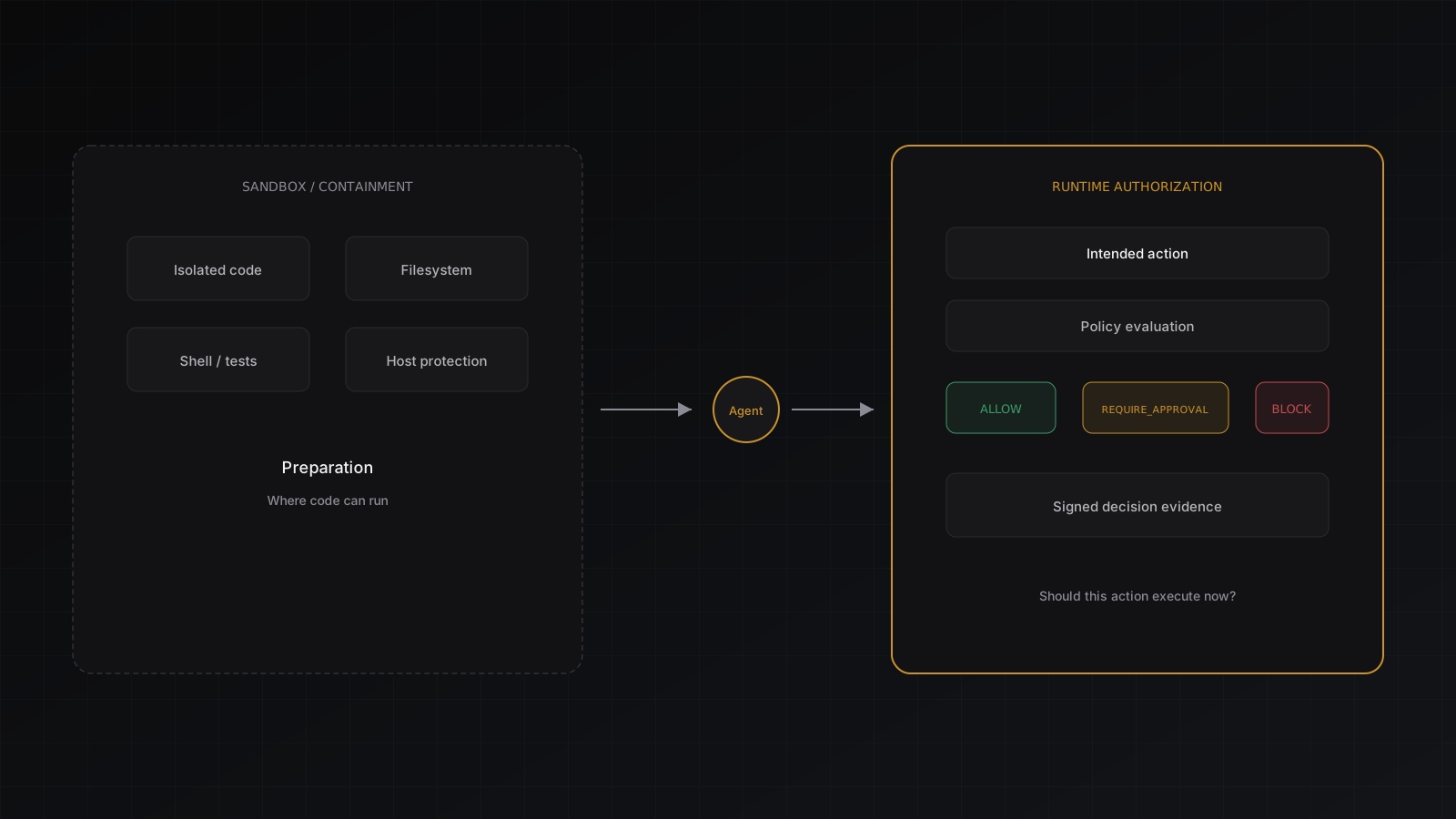
What a sandbox solves
Sandboxes help isolate model-generated code and the operations that often accompany it: shell commands, package installation, file operations, development servers, tests, and build processes. According to the isolation model in use, they reduce the chance that untrusted code damages the host machine or shared developer environment.
In short, sandboxes answer: where can agent-generated code run more safely?
What a sandbox does not decide
Isolation alone does not determine whether an agent may push to a protected branch, deploy to production, apply infrastructure changes, rotate credentials, initiate a payment, approve a refund, export customer records, or modify production data.
Not every sandbox exposes those capabilities. The point is different: when credentials, network access, APIs, production tools, cloud permissions, or database access are deliberately granted, a separate authorization problem appears. Containment protects the host. Authorization governs business consequences.
Concrete coding-agent example
The important boundary appears when an agent moves from preparing work to changing a real system.
- Agent writes code.
- Agent runs tests in a sandbox.
- Agent prepares a deployment.
- Agent attempts a production deployment.
- BobSentry evaluates the intended action.
- Decision is ALLOW, REQUIRE_APPROVAL, or BLOCK.
- The deployment may proceed only according to that result.
- The downstream outcome is recorded separately.
The execution boundary sits before step 7. Approval authorizes the action to proceed. It does not prove that the deployment succeeded.
- 01Agent proposes action
- 02BobSentry evaluates
- 03ALLOW / REQUIRE_APPROVAL / BLOCK
- 04Approval resolution if required
- 05Downstream action may proceed
- 06Execution outcome recorded separately
- 07Signed decision evidence retained
Authorization is evaluated before the downstream system changes. Evidence records the decision; it does not authorize execution by itself.
For coding-agent patterns in more detail, see How to Control AI Coding Agents Before They Push Code or Deploy to Production and Dev Guard.
Example action metadata
The following is an illustrative schema for discussion, not a promise of a native cloud or IDE integration.
{
  "agent_id": "coding-agent-production",
  "action": "deployment.production",
  "target": "customer-api",
  "context": {
    "repository": "customer-api",
    "branch": "main",
    "environment": "production",
    "tests_passed": true,
    "protected_branch": true,
    "change_risk": "high"
  }
}
Teams should not send complete source code, full diffs, secrets, access tokens, .env files, customer records, or unfiltered terminal logs. Prefer normalized metadata. See Developers for the sandbox evaluate path.
Beyond coding agents
The same distinction appears outside software delivery. These are examples of the pattern, not claims of deployed BobSentry integrations.
- Financial workflow: a sandbox or isolated worker prepares a payment; runtime authorization decides whether it may be submitted.
- Healthcare workflow: an isolated agent processes permitted data; runtime authorization decides whether an export or external disclosure may execute.
- Enterprise operations: an agent prepares a configuration change; runtime authorization decides whether production infrastructure may be modified.
Where the authorization boundary should sit
Stronger enforcement belongs in infrastructure that controls the consequential tool path, such as a deployment wrapper, required CI check, protected tool gateway, API middleware, customer-side execution gateway, or controlled workflow service.
Prompt instructions are not enforcement. Editor rules are not enforcement. A standalone evaluate call is advisory unless the caller respects the decision. BobSentry is strongest where it controls or gates the execution path. BobSentry does not currently ship a native AWS, Google Cloud, Azure, Cloudflare, Cursor, or MCP integration.
Failure modes
Plan for evaluation timeout, BobSentry unavailability, queued approval, missing approvers, a decision returned but ignored by the caller, and downstream failure after approval. Teams must choose fail-open or fail-closed behavior by action class. There is no single universal policy for every workflow.
What BobSentry does and does not prove
BobSentry can preserve evidence of:
- requested action
- normalized metadata
- policy evaluation
- decision
- approval state
- authorization actor and time where applicable
BobSentry does not itself prove:
- the command executed
- the deployment succeeded
- the payment settled
- the database changed
- the downstream system honoured the decision
Execution outcomes must be recorded separately. See Security for the metadata boundary and evidence model.
FAQ
Is a sandbox enough to secure an AI agent?
A sandbox helps protect the host from untrusted or model-generated code. It does not by itself decide whether a consequential business action—such as a production deploy, payment, or data export—should be allowed to execute.
Does runtime authorization replace sandboxing?
No. Sandboxing and runtime authorization are complementary. Isolation answers where code can run safely. Authorization answers whether a specific action should execute now.
Can a sandbox stop a production deployment?
Only if the deployment path is blocked by the surrounding control plane. Isolation alone does not authorize or deny business consequences when credentials and tools are deliberately available.
Where should the BobSentry check be placed?
On the path that would otherwise execute the consequential action—commonly a deployment wrapper, required CI check, protected tool gateway, API middleware, or controlled workflow service.
Is a Cursor rule an enforcement boundary?
No. Prompt instructions and editor rules can guide an agent, but they are not hard enforcement. Stronger enforcement belongs in infrastructure that can gate the tool path.
Does approval mean execution succeeded?
No. Approval authorizes the action to proceed. Downstream success or failure must be recorded by the system that executes the action.
Does BobSentry need source code?
No. Evaluate requests should use normalized action metadata. Keep complete source, full diffs, secrets, tokens, and unfiltered logs out of the request.
Can this work with CI/CD or tool gateways?
Yes. A practical pattern is to call BobSentry from a required CI check, deploy wrapper, or tool gateway before the production action runs, and to respect ALLOW, REQUIRE_APPROVAL, or BLOCK.
Related articles
- Runtime Authorization for AI Agents: The Missing Security Layer for Autonomous AI
AI agent infrastructure · 10 min read
- How to Control AI Coding Agents Before They Push Code or Deploy to Production
Developer agents · 12 min read